

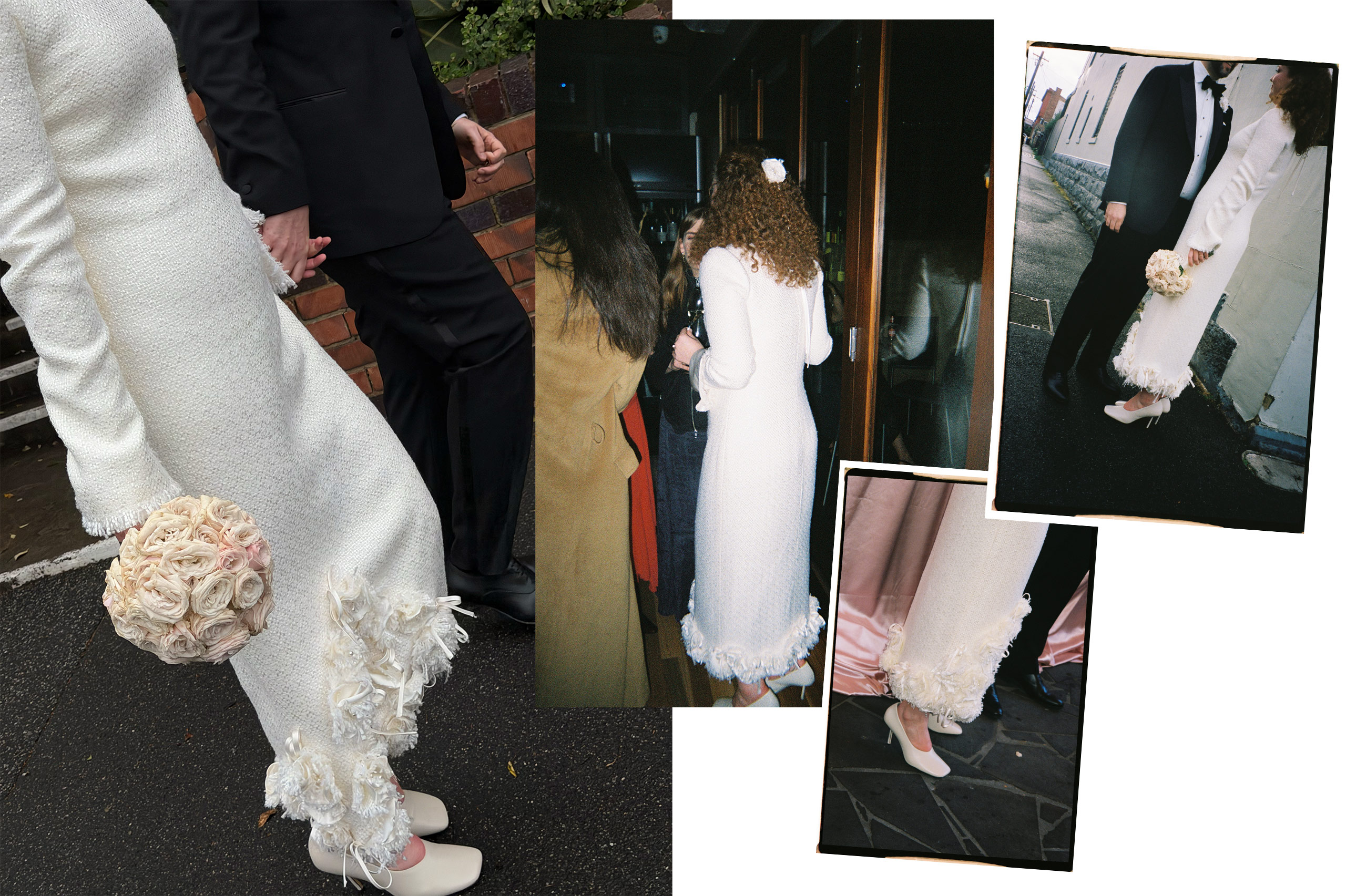
When I started looking for a wedding dress last year, I thought finding one would be about finding the one. Mostly, it became about figuring out what felt like me.
I was surprised by how overwhelming it felt to sift through so many dresses and struggle to see myself in any of them. I’d find the right silhouette, but it would be out of my budget. Then I would find something within my budget, but the colour, fabric or shape wouldn’t be right. I’d thought this would be one of the easier parts of planning my wedding. Instead, it felt like trying to fit a square peg into a round hole.

What I also didn’t expect was how determined I’d feel to stay true to myself. I’ve spent a long time, despite growing up on the internet and in the toxic soup of social media, learning to love the things that make me who I am: from my almost six-foot tall frame to my naturally curly red hair. I wanted to feel completely myself in my dress, marrying the person who makes me feel most myself, surrounded by the people we love the most.
The more I looked, the more I realised how easy it is to get lost in the wedding vortex because of the enormous and relentless visual language around what a bride is supposed to look like. It is a language that tells us to conform to a trend, a specific body shape or aesthetic. This pressure feels particularly stark when you’re trying to represent who you are through clothing on the day you’re marrying the love of your life.

Then I saw Rosalía on Jimmy Fallon wearing an off-white, textured tweed dress from CHANEL’s Spring 26 collection by Matthieu Blazy. There she was in all her ethereal beauty, radiating with her thick natural hair out and fully on display. She looked incredibly chic, but more importantly, she looked completely herself. This wasn’t a bridal look, but it easily could have been, and you saw Rosalía before you saw the dress. That was exactly what I wanted.
The search for something similar was, again, for so many reasons fruitless. So, I had another idea: perhaps I could find someone to make it locally. In a world of mass production, there was something special about local bespoke tailoring and dressmaking. Sitting down with someone, talking through what you want and watching a dress take shape specifically for you felt like a different way of approaching the whole process. Rather than trying to find myself in a design, I could create one that felt like me.
This is my guide for how to design and make your own wedding dress.

1. Trial and error
It is so important to try on wedding dresses to see what you like, even though you may not intend to purchase them. It’s a phenomenal way to collect clear data on your preferences, what looks good on you, and what photographs well (which are all very different considerations). I went to Courtney at Lola Varma and Cecilie Bahnsen in Copenhagen to try on literally everything they had. It was also great that these were two ends of the spectrum when it came to a dress and both experiences were extremely affirming and empowering. I also asked around from friends to family on what they envisioned, it was very helpful.

2. A very strong understanding of how you want it to look – fabric and beyond
One of my best friends had dreamt up the dress before I saw the Rosalía CHANEL dress. She said to me: “I can see you in an ankle-length, straight something with long sleeves.” That and all the data collection gave me a very clear starting point and meant I didn’t have to lean too heavily on my dress designer for the design itself. It is important to understand about custom: you’re not going to a dressmaker for a design service. You’re bringing the idea, and they’re helping you bring it to life. They have the craft, technical knowledge and an understanding of what will work. They can tell you what is and isn’t possible and guide you from there.

3. Find the right person and have the initial chat
Get on the hunt for a dressmaker or tailor. I found Sophia at Inpira after seeing a vintage dress she had altered for a bride. Sophia makes and designs her own collections, so I went out on a whim and asked her if she did custom. I sent her my brief and asked a lot of practical questions upfront such as: How long would it take? What would the process involve? Could it work within my budget?
You’ll spend hours together being measured, fitted, questioned and re-questioned, so finding someone you trust matters. From my first conversation with Sophia, she was incredibly attentive and respectful. She asked about everything from the length and fabric to how I wanted to move on the day.
She also gave me a clear written plan with dates for fittings, payments, and when I needed to have things like my shoes ready. Be clear about your vision, your budget and what matters to you, then let their expertise help you get there. Lean on the dressmaker – but not too much.

4. Cost
It’s important to note that designing a custom dress isn’t necessarily a way to cut the cost of a wedding dress. You’re commissioning someone with immense skill and experience to make something completely unique to you. You’re paying for their time, craftsmanship and materials.
When you boil it down, it can feel more valuable to be investing in a local industry and all the skills associated with that piece. You also aren’t paying for alterations on top of a set price because of course the dress is built from the toile (a cotton draft of your dress) up. You’re not paying for a label or a seasonal collection; you’re paying for the person, the process and something made specifically for you.


