

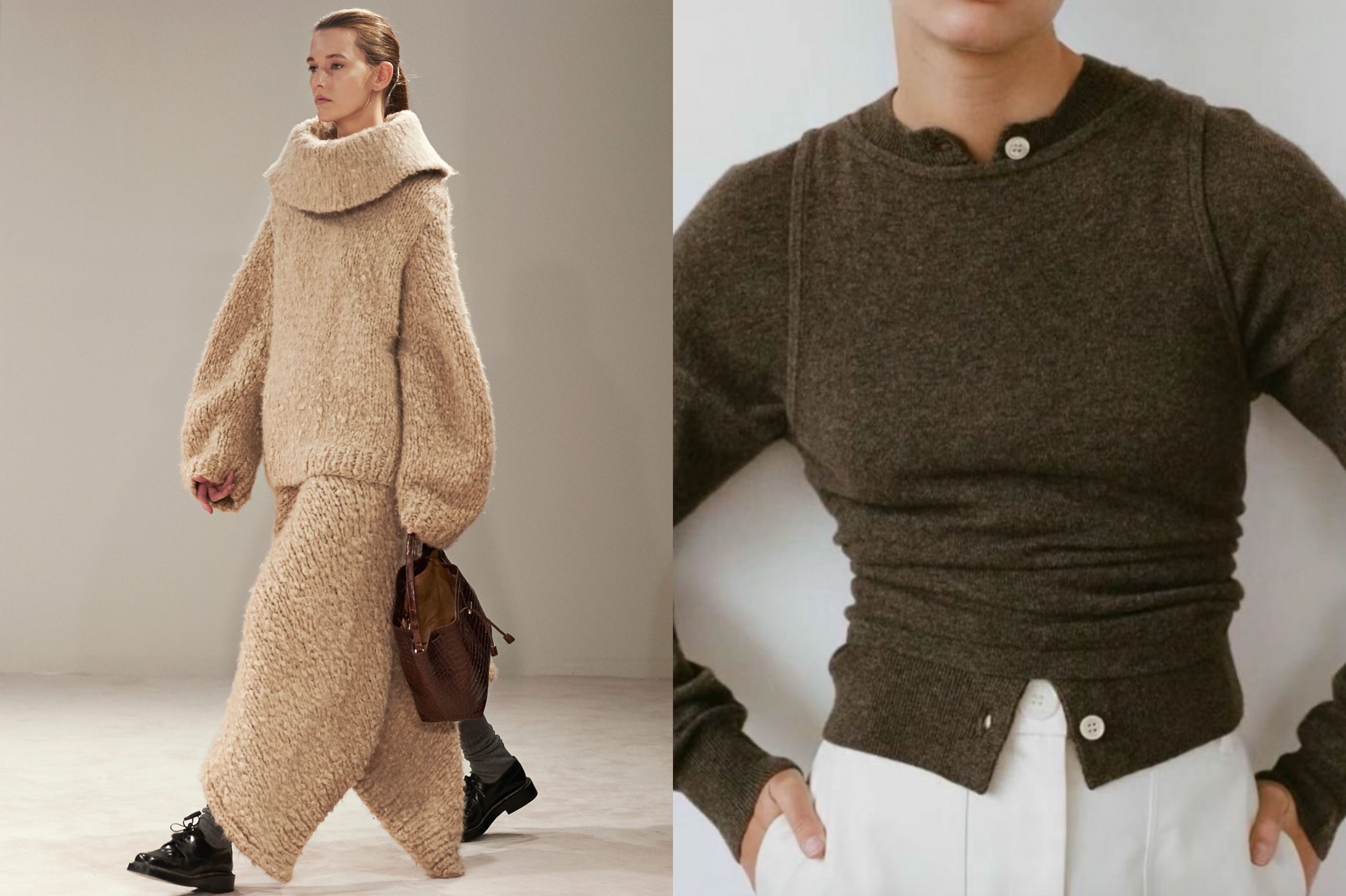
If, like us, you woke up today and couldn’t feel your toes – no, this isn’t hyperbole – it may be time to accept the fact winter has hit Australian shores. Gone are the trans-seasonal jackets and cropped cardigans that look good rather than serving as protection. It’s time to pull out the trench coats, the chunky scarves and next-level knitwear.
If you’re yet to invest in some new warm knits or coats, or are simply looking to upgrade your staples for the winter ahead, knowing which fabric to purchase is key. The two most common fabrics employed for winter garments? Wool and cashmere, both famous for their warmth and versatility. Unsure which is best for you? Read on to learn the origins and warming properties of the fabrics.
What are the key differences?
In a nutshell:
- cashmere is more delicate than wool (and thus requires more tender love and care)
- cashmere is softer, lighter, and warmer than sheep’s wool, but it comes at a higher price
- wool is more durable, hard-wearing, and easier to clean.
Which one should I buy?
Both have their merits – it generally just depends on what it is you need that will determine the most appropriate fabric.
If you’re looking for an everyday knit that can handle regular wear and requires less maintenance, wool is often the more practical choice. If comfort, warmth, and a luxuriously soft feel are your top priorities, cashmere is hard to beat. Both fabrics are subject to pilling, because they are natural, animal-hair fibres.
Many people choose to have both wool and cashmere in their wardrobe: wool for everyday use and cashmere for elevated, special-occasion dressing.
Is one scratchier than the other?
Cashmere is generally softer and less scratchy than most types of wool because its fibres are much finer. Traditional wool can sometimes feel itchy or coarse, especially if it is made from thicker fibres (fibres that are over 30 micron that create the itch factor), although high-quality wool varieties such as Merino wool (19.5 micron) are much softer than standard wool and are soft against the skin.
If comfort is your top priority, cashmere is usually considered the more luxurious and skin-friendly option, or looking for a Merino wool at a lower fibre diameter than 30.
Which one is warmer?
Both wool and cashmere will keep you warm, however there are caveats. As the fibres of cashmere are much finer than wool, cashmere is better at trapping heat without adding extra weight or heaviness to the garment itself. However, the thicker fibres of wool make the material more durable, albeit slightly rougher on skin.
If you’re prone to feeling too hot once rugged up, cashmere can be the better option to shop as it doesn’t come with the stifling quality that wool can sometimes conjure.
What exactly is wool?
Occasionally known as fleece, wool is derived from the covering of certain animals including sheep, goats and alpacas, and commonly used to make clothing, blankets and furniture. Wool has been employed for centuries for its warming properties and, unlike leather, doesn’t cause any harm to the animal it is procured from. Fibres are removed from the animal through sheering and this occurs once annually, when the weather warms for spring.
What are the most common types of wool?
The two key types of wool to know are sheep’s wool and merino wool.
As the name suggests, sheep’s wool refers to all wool taken from any breed of sheep and is the most common type of wool available across the globe. It’s moisture and bacteria resistant and doesn’t absorb odours as much as many other common materials, like linen and cotton. Sheep’s wool is a warm fabrication, yet can be heavy, course and, on occasion, can feel scratchy on skin.
Sheep’s wool differentiates from lamb’s wool as this is harvested from a baby sheep, whereby the fibres are much more fine and are known to break quicker and pill. Pilling – much like in skincare – is when the wool begins to ball up on garments, often an unappealing quality to the fabric.
Merino wool is a more elevated type of wool that comes from the Merino sheep native to Australia and New Zealand. Merino wool is renowned for its ‘wicking’ properties, whereby it moves moisture from next to the body out through the clothing. This is why merino wool is often employed when making performance clothing.
How do you care for wool?
As mentioned, wool is a durable, sturdy fabric and can withstand considerable wear and tear over seasons. Most wool garments can be machine washed permitting they are laid flat to dry, meaning the are very straightforward and user friendly when it comes to care.
What exactly is cashmere?
Cashmere comes from the fine hairs of goats, specifically their soft undercoat, with the fibres primed for the make of fine knit garments. Instead of shearing the animal, cashmere is harvested by hand during the spring moulting season, with only 50-80g of the fibre harvested from each goat. Thus, cashmere is much scarcer to source than wool and, in addition to its luxe feel, means it comes at a higher cost.
True cashmere can only be sourced from the goats of Mongolia, China, India, Iraq, Iran and Afghanistan. Similar to seersucker, cashmere shawls originated in India and made their way to Europe while India was still under British rule, and is now employed frequently in the make of winter clothing.
How do you care for cashmere?
Cashmere is more delicate than wool and thus requires more tender love and care.. The softness of cashmere can result in pilling, meaning investing in a cashmere comb will be advantageous to rustle out the pilled fabric from garments. Improper cleaning can also easily damage cashmere garments, and typically the material fares much better when infrequently cleaned. As cashmere doesn’t retail as much odour as other fabrics and retains its shape better, some suggest hanging the garment in the bathroom while showering is a simple way to steam clean it after use.
Where to shop for wool and cashmere
In Australia, there’s an abundance of wool and cashmere product on the market. But the places we keep on returning to for high-quality garments that stand the test of time, offer 100% wool or cashmere fabrication, and which offer a great price point or unique design are:
1. Uniqlo

Locations: multiple and online
Uniqlo is one of the most universally available shops in the country (with stores across most major cities, as well as fast online delivery options for all the far-reaches of the country). They stock 100% wool and 100% cashmere garments across many menswear, womenswear and childrenswear styles – and at arguably the most accessible price-point you’ll find (around $150 for a 100% cashmere sweater).
2. Assembly Label

Locations: multiple and online
Across both menswear and womenswear, Australian brand Assembly Label has some of the most accessibly priced 100% cashmere and wool garments you can buy. They have a bunch of classic styles and in a range of colours too.
3. McIntyre Merino

Locations: Sydney, select stockists and online
Melbourne-based brand McIntyre Merino designs quality Merino knitwear for both men and women. They use 19.5 micron (and finer) Australian merino wool, so they’re incredibly soft against the skin. For a more tailored fit, you can visit their Paddington boutique in Sydney, or one of their stockists around the country.
4. NAGNATA

Locations: Sydney, select stockists and online
Byron Bay-based activewear label NAGNATA has been pioneering 100% wool gym clothes since 2015. But in recent years they’ve also branched out into more traditional sweaters and knitwear from Alpaca wool and wool blend. Because their garments are certified by the Global Organic Textile Standard, no chemical pesticides have been used in growing the cotton either.
5. Friends With Frank

Locations: Melbourne and online
The Melbourne-based ready-to-wear label has a great selection of wool and cashmere scarves, sweaters and cardigans in seasonal colourways. Most of their knits are either 100% Merino wool or a blend of both wool and cashmere.


Feature images: The Row F14 via GoRunway and Friends with Frank Instagram.
