

In partnership with Canada Goose
I’m a self-confessed ‘Urban explorer’. I usually feel most comfortable when surrounded by the sound of a cosmopolitan landscape rather than the echoing vibrations of nature’s silence. Flying north from Perth over the Pilbara in Western Australia, I could not draw myself away from the window. I realised that this trip was going to be like none I had ever taken before and I confess, in that moment, it made me nervous. Canada Goose had invited me to take part in the Australian leg of a great expedition, in the Karijini National Park. Of course I had pre-Googled what to expect like anyone else would do, but you can’t Google the energy a place has, or the immense impact it can have on you, physically and emotionally. I was about to find out firsthand the awesome and overwhelming power of nature, its harshness and its sublimity.

We landed in the smallest airport I had ever seen – no gates, no baggage claim. Just a tin shed and a makeshift security area. Stepping off the plane, the air felt different. It was hot but not stifling, and smelled vaguely of clay and unidentified flora. When we had found our luggage we were greeted by Elle, who was to become our hiking guide over the next few days, and were bundled into a van along with our many, many suitcases. This was the point where we left the Sydney city folk behind, and began our journey to discover our Natural Intelligence. For Canada Goose, Natural Intelligence is rooted in the idea that nature is the world’s oldest operating system – a source of knowledge that can only really be understood through direct, devoted contact with the natural world.
The idea extends to the brand’s Natural Calendar, a series of experiences shaped around the rhythms and milestones of the natural world. Rather than treating nature as a backdrop, the calendar encourages a closer attention to the way the world around us changes – from the movement of the seasons to the celestial events that mark time. Karijini was our opportunity to experience that philosophy firsthand, immersing ourselves in a landscape that has been shaped over billions of years. Rather than simply observing the landscape, we were encouraged to pay attention to what it could teach us – its changing temperatures, ancient formations, waterways, wildlife and the knowledge held by its Traditional Owners. It was a kind of teaching that only a land billions of years old can offer you.

Pulling into the Karijini Eco Retreat after a long drive through flat landscapes dotted with jutting mountains, I found that my lodgings were simple but surprisingly comfortable. In the middle of such a vast landscape we were treated to tents with hot water and electric blankets (mandatory, as the evenings and mornings were ice cold).
The hospitality of the Eco Retreat was second to none; local food was prepared thoughtfully, and tales of the area’s past weather events, wildlife sightings and star patterns were told over a candlelit dinner using Australian ingredients. After a long day of travel, the group fell back to their tents at a brisk jog, the biting cold nibbling at our ankles.

When dawn broke the next morning I felt the chill of the Western Australian wind instantly, so I opted to get dressed under my duvet (as most of the group did), throwing on my Canada Goose Quest Jacket, and starting for the gorges. Across the expedition, the clothing became another way of understanding the landscape. Canada Goose’s 2026 collections span the full spectrum of changing conditions, from lightweight pieces designed for warmer environments to protective outerwear engineered for more demanding elements. In Karijini, where the temperature could shift dramatically between the cool of early morning, the intensity of the midday sun and the freezing nights, that adaptability felt particularly relevant. It also brought the idea of Natural Intelligence back into focus. Just as the expedition encouraged us to pay attention to the cues of the environment, the collection is built around responding to those cues – considering what the body needs, how the climate changes and how design can work with, rather than against, the natural world.
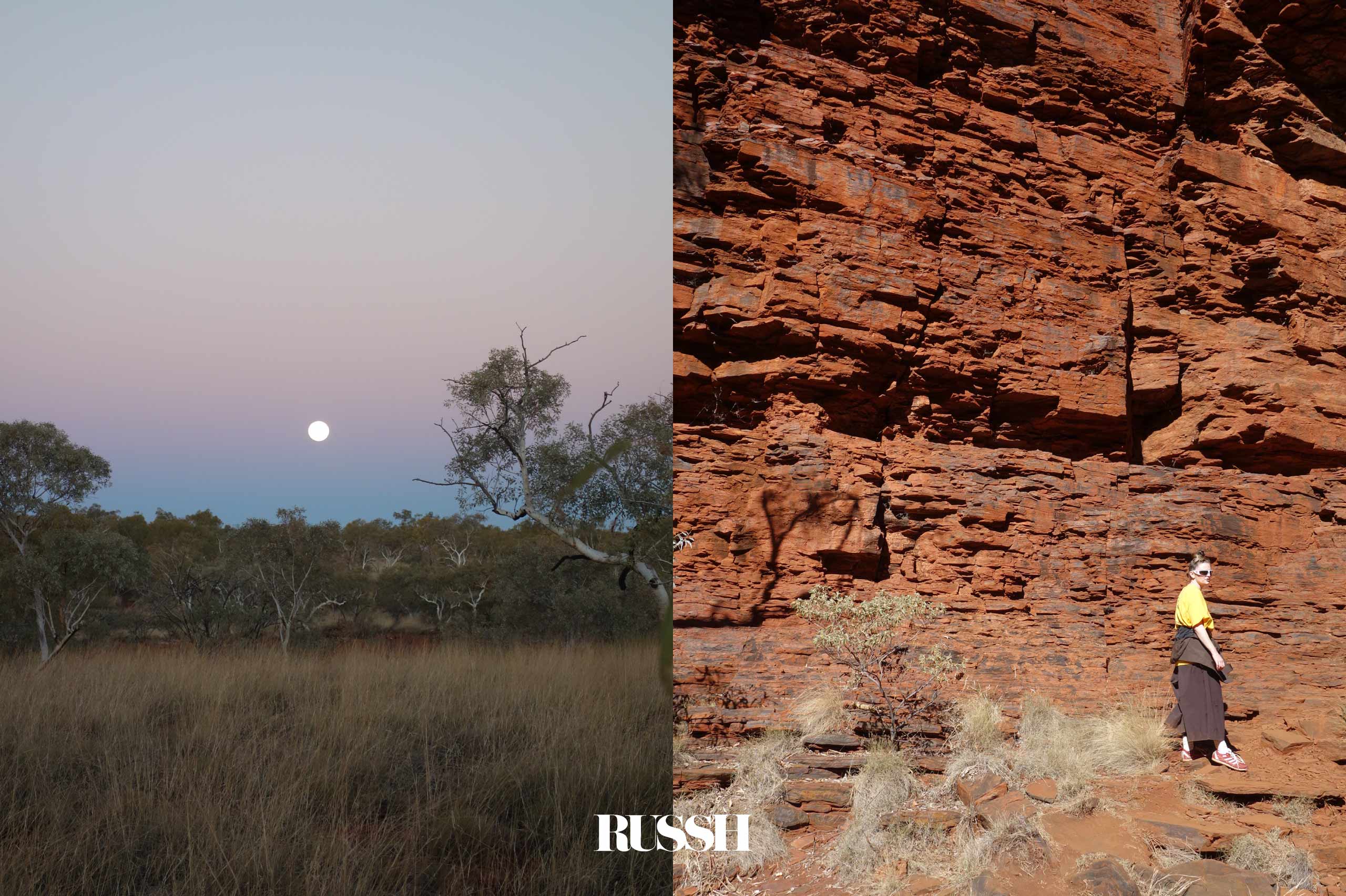
Our first trek was to be the hardest: Weano Gorge, which was physically intense. After a gruelling couple of hours scrambling down hillsides and trying desperately to trust my own footing, the gorge opened out to a translucent natural pool. The red cliffs surrounding the pool danced with the sun’s reflection, so the entire area felt like it was sparkling. This, coupled with the sparkling seams of iron ore in the rock, truly felt like nature’s disco.
After conquering Weano, we headed to an equally spectacular gorge, Hamersley, for another four-hour hike through some of the thinnest slot canyons in the park. Admittedly, after eight hours of non-stop hiking, I was exhausted, and the chance to stop at the Spa Pool and sit for a while in contemplation was one of my highlights of the entire trip. My eyes may or may not have closed for a moment or two but hiding behind my Canada Goose Summit glasses, no one was any the wiser. Sleep that night felt eternal, and never more deserved.

The next day I felt the confidence of someone who had battled the elements and won. My body felt symbiotic with the land, my natural intelligence was flowing, and I felt a deep connection with my surroundings. Our hike through Dales Gorge felt less laboured, and when asked if I would prefer the ‘easy’ or ‘hard’ routes, my answer was always the hard one. My fingers found holds in the rock face more easily, my feet felt anchored and even my muscles began to ache less. Passing waterfalls, countless red monuments, and natural spring streams that grew green with unexpected plant life, we came to rest at Fern Pool.

The First Nations people have a story about a giant serpent, who slithered across the land in the Dreamtime, carving out gorges and waterways along the way. The serpent’s spirit is the protector of these environments and at Fern Pool, the Traditional Owners have a greeting for him, which travellers are asked to do out of respect. You take some water in your mouth then spit it back into the pool saying ‘I am one with the land, I am not here to harm it.’ I took some time to sit by this pool and watch its lone inhabitant, a rather inquisitive kookaburra. I thought about the landscape, the waterways and the billions of years before me that this land had existed. Being there, a small spot in history, on the most ancient land, with the blessing of the oldest culture on earth, was surreal. The gratitude I felt was immense.
The Karijini Visitor Centre is an architectural marvel, perched on a slight slope in the middle of the park. Designed to curve like a goanna, and housing sacred artifacts and stories of the Traditional Owners, it pays homage to the history of Karijini, both ancient and modern. It is a history that in modern times has had such a fierce duality: the Banyjima (Banjima), Kurrama, and Innawonga (Innawongka) peoples, their families, and the sacred knowledge they have passed through hundreds and thousands of generations, alongside the lesser-known histories of their people. Then, the recent mining boom, and the misuse of lands they have been custodians of and feel an incredible connection to. I left the visitor centre with an even deeper respect for the First Nations people of Karijini, and their fight to keep it sacred.
A small part of me has been left in Karijini National Park. It’s a piece of me that pulls on my heart slowly and gently, keeping it in my thoughts, and ensuring I come back. There is an old wives’ tale in the area that if you take a piece of Karijini home with you – a rock, a stick, some dirt – the park will haunt you until you take it back where it belongs. I didn’t bring anything home with me, but perhaps the haunting works the other way also. Karijini you are in my dreams.


