

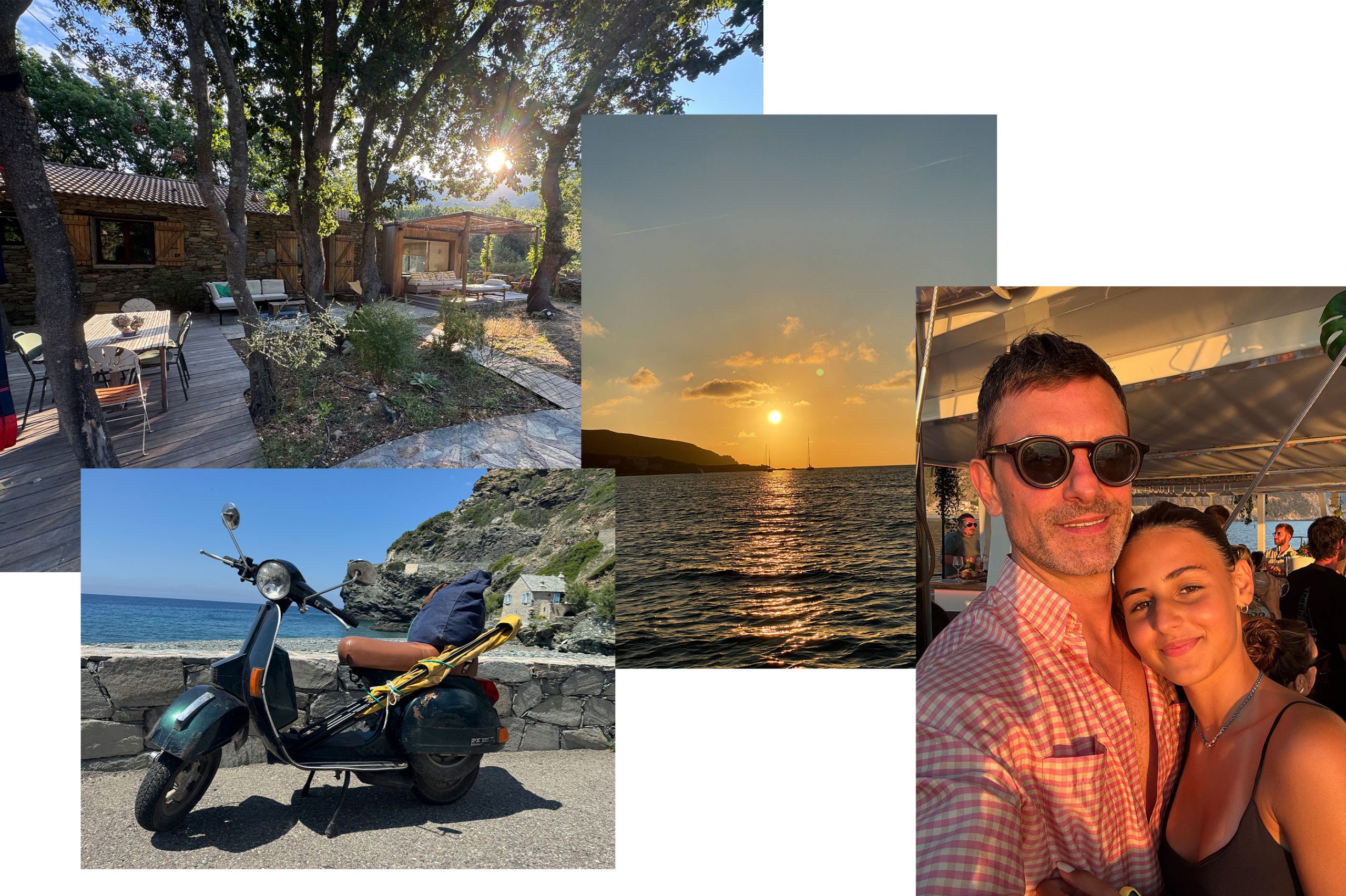
Corsica is where I come from. My childhood is there, in the north of the island. Then I spent years travelling far from it, without ever really leaving it behind. In 2021 I came back and bought a small bergerie, an old shepherd’s house, on farmland above the Patrimonio vineyards, surrounded by forest and maquis.
Two worlds live side by side here, the mountain and the sea. In the same hour you can be up in the maquis, with nothing around you but rock, scrub and that smell, and then down in the water. The house sits between the two. That is exactly why I chose it.
I get around on a Vespa. It is the right speed for these roads, and it brings a little of the Italian dolce vita with it. Italy is only a few kilometres across the water, and you feel it here, in the food, in the language, in the way people take their time.
I have been restoring the house ever since, and I am still restoring it. It is a life project more than a renovation. I wanted something simple. Wood, stone, and ceramics I find locally or bring back from elsewhere. I look for objects that carry the trace of a hand. I keep what was already here and give it another life. An old shutter became a coffee table. The things that hold the soul of a place are the ones you should never throw away. You cannot manufacture that kind of truth. Less is more here. The nature on this part of the island is still intact and it puts on a show every evening. It needs no artifice. The materials and the elements speak for themselves.
The house is called Baraccò Argia. In Corsican, a baraccò is a small farm building. Argia was a Corsican woman I had the good fortune to spend time with when I was young. She opened me to drawing and painting, to music, and to joy. Naming the house after her was obvious. Much of what I do with my hands today started with her.
What I love, far from the distractions of a city, is finding people who are serious about one thing. Matteu, at Da Noi in Nonza, cooks the way you wish everyone cooked. A ceramicist in my village, Julien from Atelier Julien Truchon, works organic shapes you will not see anywhere else. A farmer in the Nebbio grows fruit and vegetables all year round, the old way, for himself and for the few people who know him. You do not find these people in a guidebook. You find them by staying.
A place where we lean in to time and embrace the process. Spending quiet moments in some of nature’s more beautiful hidden gems, like Plage du Lotu with over a kilometre of white sand, clear turquoise water, maquis all around. No road leads there, and that’s the point.
The jewellery comes from the same place. At Atelier Paulin we hand-shape precious wire in our atelier in Paris. Nothing is hidden and nothing is added. A hand, a wire, a shape that belongs to one person. I believe in what the human hand can do with what nature gives, when it shapes it to live with it rather than against it. That is what I look for here, and that is what we make.
The pieces live outdoors. Salt water, sun, sand, a swim before dinner. They are made to be life-proof, and mine have not left my wrist in years. Corsica is hard on things.
The Australian connection came to me by surprise. A few hundred metres from my house lives a neighbour, an artist, who has been here for more than 15 years. I only met her recently and I did not expect her to be Australian. I asked her how she had ended up in the Nebbio. Her answer stayed with me. Australia is a vast island, she said, and many people who grow up there learn to live in symbiosis with nature, with the softness of the elements and the spectacle of a landscape left intact. She found the same thing here.
The light and the sea are everywhere in both places. Since that conversation I have been convinced that the day I set foot in Australia, I will feel at home.
Corsica does not ask much of you. Good shoes, a mask, an appetite, and time…


