

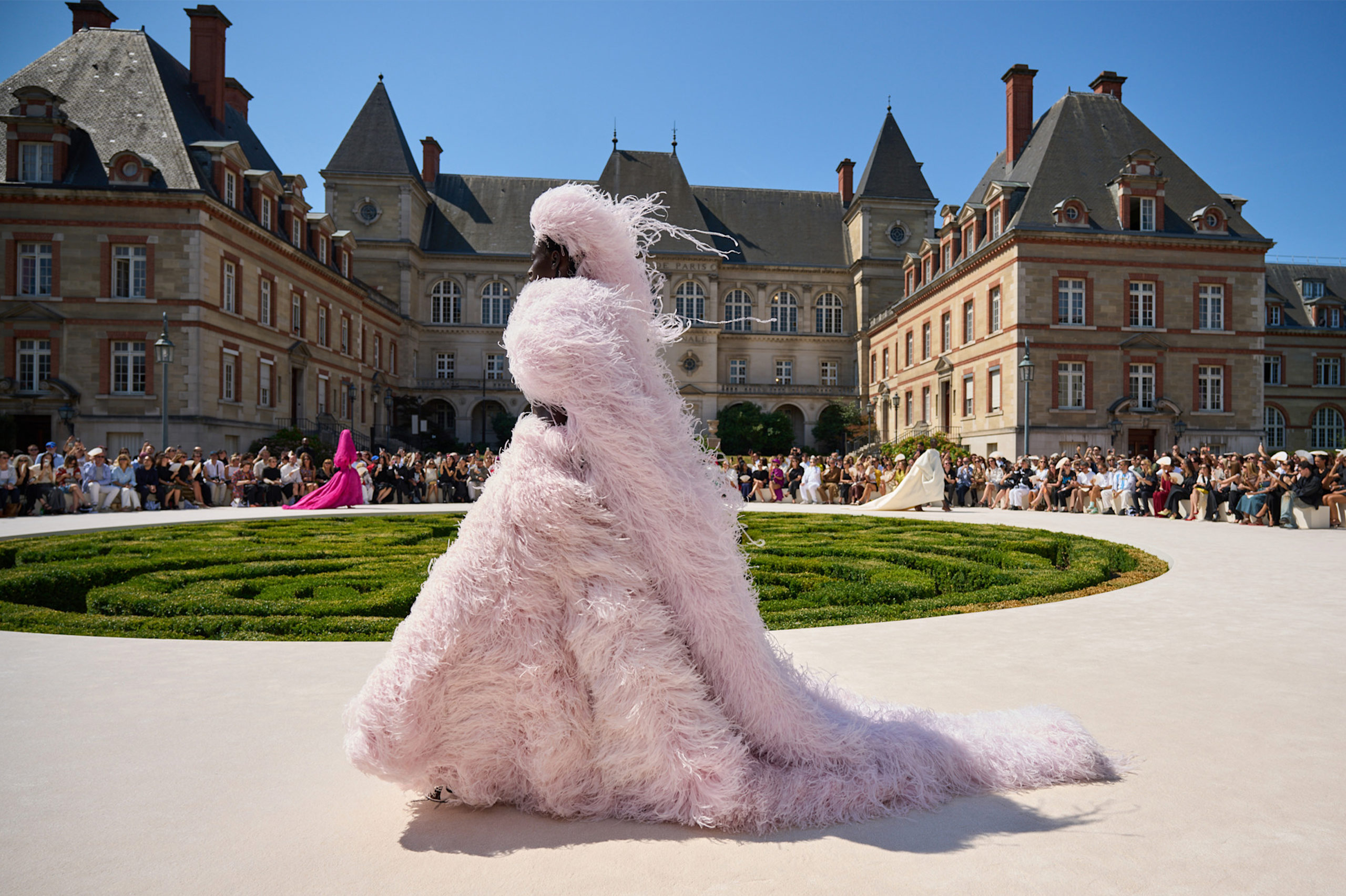
Few fashion houses carry the weight of Balenciaga. When Christian Dior famously described Cristóbal Balenciaga as “the master of us all,” it wasn’t hyperbole. Cristóbal was a designer who changed the architecture of fashion itself. There was the cocoon coat. The sack dress. The balloon silhouette. He taught us that couture could sculpt space around the body instead of merely adorning it. Even after closing the house in 1968, his influence never really left.
Which is precisely why taking over Balenciaga has always been one of fashion’s least enviable jobs.
Every creative director arriving at a heritage House is tasked with the same impossible brief: honour a legacy that has already rewritten the rules while somehow finding a language of your own. Too much reverence and the work becomes costume. Too much reinvention and it stops feeling like the Maison altogether.
Pierpaolo Piccioli, it turns out, understood the assignment perfectly.
His first haute couture collection for the house was presented at Paris Couture Fashion Week beneath the midday sun at the Cité Internationale Universitaire de Paris. Unlike many of its contemporaries this week, the setting was pared back – just a courtyard kissed by clipped hedges, warm stone, and a sand-coloured carpet for a runway.
I think one of Piccioli’s strengths is that he doesn’t try to compete with Cristóbal – or even Demna. Nor does he attempt to erase what came before. Instead, it felt like a conversation between designers united by an obsession with shape, proportion and emotion.
Piccioli’s signatures were immediately recognisable: fearless colour (this collection’s palette a thrilling combination of chartreuse, tirquoise, pinks, greens and plums), romantic volume and an unwavering commitment to textural detail. But despite it feeling distinctly Pierpaolo, everywhere you looked were echoes of the founder. Monumental cocoon silhouettes, sweeping backs, drop waists, and sculptural tailoring. But rather than attempting to replicate, these felt like evolutions.
The collection was also radical in its craft. Leather interiors were moulded from 3D body scans to create hidden structures beneath cashmere. It introduced bioengineered AmSilk into couture for the first time. Thousands upon thousands of hand-cut petals and painstakingly placed feathers and scale-like sequins transformed technical innovation into something almost impossibly light and connected with the natural world.
When Piccioli emerged with the atelier for the finale, the applause felt directed as much towards the craftspeople as the designer himself. In the endless curve of front row were Anna Wintour, Cynthia Erivo, Teyana Taylor, Lily Collins, Hudson Williams, GIVĒON and Demi Moore.


