
In partnership with Nike
Venice is a city that asks you to move differently. There are no straight lines here; instead, paths fold into bridges, stone gives way to water, and every journey becomes a negotiation between where you are and where you are trying to go. For Bangarra Dance Theatre, there is something fitting about arriving here at a moment that asks the company to consider both where it has been and where it might move next.
This year, Bangarra received the Golden Lion for Lifetime Achievement in Dance from La Biennale di Venezia, becoming the first Australian company to receive the honour. It is a remarkable recognition for a company whose work has spent more than three decades carrying Aboriginal and Torres Strait Islander stories, cultures and ways of knowing onto stages around the world.
And yet, for Bangarra Artistic Director and co-CEO Frances Rings and five of the company dancers Kallum Goolagong, Maddison Paluch, James Boyd, Donta Whitham and Tamara Bouman, legacy is not something that can be easily fixed in place.
“When you’re in this kind of job, you’re constantly questioning yourself. You never really think you’re good enough. Then you go overseas and, especially on a trip like this, you’re being presented with an award, which is huge. It was a moment to recognise our contribution to the company, and who we are as artists and as people. To be there meeting other artists and dancers, surrounded by so much talent, you’re seeing greatness within greatness. It was refreshing and completely different,” shares Goolagong.
“In my eyes, it’s the dancers I grew up watching and admiring who won this award. And my role now is to hold it and celebrate it for the next generation,” shares Bouman.
There is history in every Bangarra performance, but there is also the present tense: bodies moving, stories being interpreted and knowledge passing between generations. In Venice, where the company presented the European premiere of Terrain at the Biennale Danza 2026, those threads converged. Home was thousands of kilometres away, yet Country, community and the generations of artists who shaped Bangarra before them were not.
“At Bangarra, we follow what we call our Creative and Cultural Life Cycle. Every new work begins with seeking permission from the community whose story we hope to tell, and building a relationship grounded in trust, respect and integrity. We have a saying about “having 100 cups of tea”, because these relationships can’t be rushed. Our Elders and communities lead the way, shaping what can be shared, how the story should be told and whether the time is right to tell it,” shares Rings.
“A work can take up to four years to create, from those first conversations and time on Country through to research, development and performance. Once the work has toured, we return it to Country and to the people who entrusted us with their stories. It’s a deeply reciprocal process: the story is shared with us, carried through the work, and ultimately gifted back to the community it belongs to.”
Perhaps footsteps are an apt way to think about legacy. We inherit some. We follow others. Eventually, inevitably, we leave our own.
It is here that another story begins to surface beneath the feet of the company.
More than half a century ago, Nike co-founder Bill Bowerman was preoccupied with the impression a runner left against the ground. Experimenting with traction would lead to the now-famous waffle outsole and, eventually, one of the earliest shoes to bear the Nike Swoosh. The pattern it left behind reminded Bowerman of the footprints astronauts had recently pressed into the surface of the Moon. And so, the Moon Shoe had its name.
Only a handful of the originals were hand-cobbled. Unlike so many silhouettes within Nike’s vast archive, the Moon Shoe was never retroed, allowing a utilitarian experiment in running performance to gradually acquire an almost mythical status. More than 50 years later, it has finally returned.
What remains compelling about the Moon Shoe is the simplicity of the idea that created it: movement presented a problem, so design found a way forward. The contemporary iteration stays close to that original proposition – low to the ground, soft and deliberately deconstructed – while reconsidering what a performance object can become once it leaves the track.
For the Bangarra dancers in Venice, that question takes on another dimension.
“I have always loved the idea of expressing myself through clothing and fashion, and what I love about fashion and dance is that they both create universes for you to immerse yourself into. The interesting part for me has always been around the why – why you wear an item of clothing or footwear also represents your association to it and how you perceive yourself within that association,” shares Whitham.
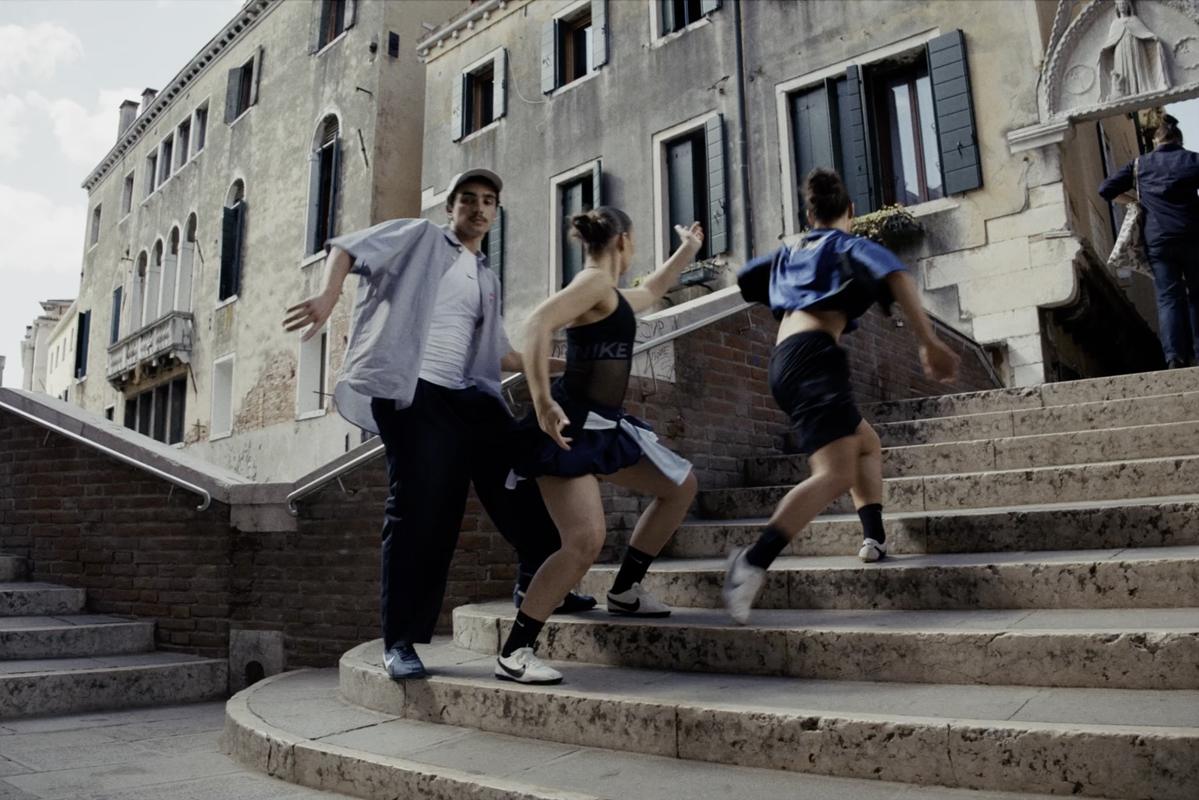
A shoe once engineered for runners moves through the city differently here: beneath wide-leg denim, with a baby tee, between rehearsal and performance, across bridges and worn Venetian stone. Each dancer finds their own language for it.
That evolution is embedded in Nike’s approach to the Moon Shoe today. The waffle outsole remains a tether to its beginnings, while new materials and interpretations move it beyond them. What began as performance innovation has become something more personal: an object whose meaning changes according to the person wearing it.
“The Moon Shoe is great because it can be every day or it can be dressed up. While we were in Venice, it was so warm, so it was nice to have a lightweight shoe that you could throw on with any kind of outfit. I love the white and the black colourways – they’re so versatile and you can really wear it for any occasion. With trackies to the studio, or with a cute pair of denim shorts, I love being able to experiment, especially when our lifestyle is so go go go,” shares Paluch.
For Bangarra, the stakes of legacy are, of course, of an entirely different magnitude. But standing in Venice, there is a thought that lingers: history survives not because it remains untouched, but because it continues to live.
“The beautiful thing about dance is that it’s a language that is understood across the world. We’re not trying to harshly educate people through words, and it allows you to have your own opinion on how much further you want to dive into what we’re [Bangarra] trying to say.” shares Paluch.
Sometimes movement can be more powerful than words, and our ability to get up on stage and tell stories of our First Nations people especially on the world stage was an incredible moment of realisation. Wow, we’re empowering our people and we’re bringing them along with us on this journey.”
“No matter where I am in the world – especially recently in Venice – I always feel connected to home and to the stories of First Nations people. My Mum and I have always said that we are connected by the stars, and looking up at the sky while we were away, that has never felt more true,” reflects Boyd.
“I feel like there’s a before Venice and an after Venice, and that experience is going to stay with the dancers for the rest of their lives and careers. They understood why we were there, the significance of Bangarra on the global stage and that this was a historic moment,” shares Rings.
“Receiving the Golden Lion wasn’t only a recognition of Bangarra as a company, but of the hundreds of dancers, creatives, cultural consultants, community members, staff and production teams who have each left an indelible mark on Bangarra and shaped where it is today. I was incredibly proud of what they were able to achieve, not only for the company, but for themselves.”
The footprint, after all, is evidence of both things at once. Where you have been, and the fact that you kept moving.


