

“The past is now part of my future,
The present is well out of hand.” Joy Division, Heart and Soul
Taste is not an easy word when it comes to music. Conversations can quickly become hierarchical as to who is the auteur of ‘good’ taste, to be quickly met with counter-culture contrarians who want to revel in promoting ‘bad’ taste and celebrating its merit, John Walters style. Discussing taste within music often requires holding two opposing ideas in your mind: one that revels in the subjectivity of personal likes, and one that suggests some things are objectively ‘good’ and are universally agreed upon. These universally agreed upon standards of ‘good’ are ultimately what is needed to spawn the rebellion of counter cultures that need a truth or a sound to invert. Could we have had punk without established and well-liked ‘popular’ music to kick against? Could we have had Joy Division without having, say ABBA? There is a special sort of power within the writing that allowed a punk band like Joy Division to transcend genre and origin.
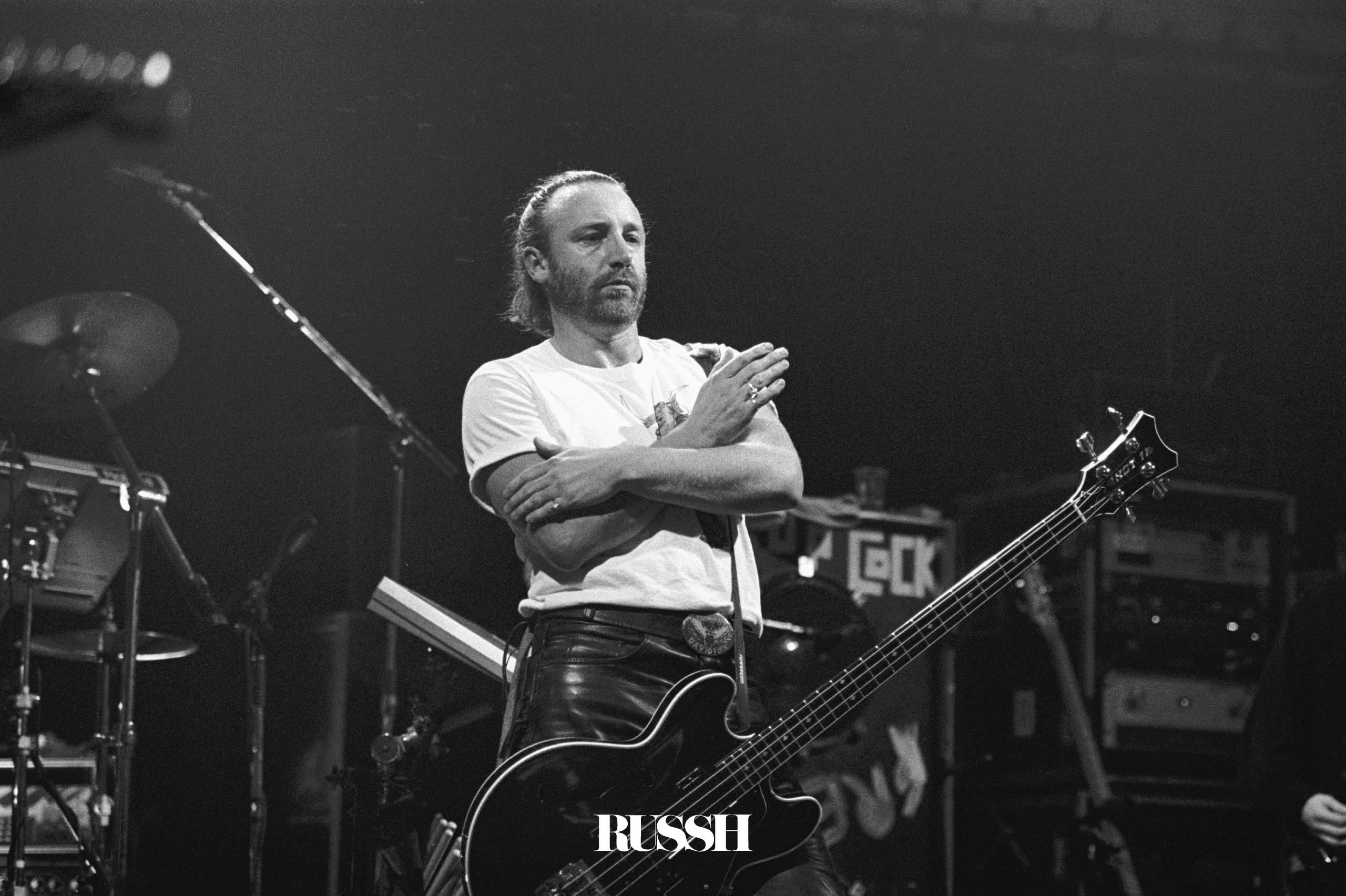
There are musicians whose work belongs to a period, and there are those whose work seems to loosen itself from time entirely; Peter Hook sits somewhere in this liminal space. As bassist and co-founder of Joy Division and its successor New Order, he helped invent a language of modern feeling: austere, romantic, mechanised and haunted. His work is somehow instantly recognisable and equally hard to fathom. Hook’s basslines do not support a guitar part – simplistically moving through 1,4,5. Instead, they melodically weave through the structure, create space, and mirror the lyrical tone.
How does one prepare for an interview of such magnitude? I didn’t have a chance to re-listen through the back catalogues of all Hook’s music from the past five decades. However, hours of late teenage and early 20s listening proved not to be a waste of time. In lieu of weeks of preparation, I wondered if I should sport my 80s Joy Division bootlegged Nietzsche t-shirt, stolen from an ex-boyfriend’s Father, to prove I was legit. Regardless, I went in curious and wide-eyed to be met with a natural conversationalist still in active dialogue with his own mythology. For all the gravity that surrounds the music, Hook speaks with the fluency of someone who understands that art is never as clean as its afterlife. It is made in rooms, on bad equipment, through accident, stubbornness, boredom, loyalty, ego, and grief.
“The strange thing about concerts these days, to me, is that they’re the only escape that a lot of people get. This world is getting worse and worse. We come together in a place and enjoy stuff that we wrote and shaped our lives, just so we can forget.”
We begin with a question about how he defines an ‘album’. Once a sacred structure, an object, a sequence, or a period of time pressed into vinyl, now the word has become elastic, a kind of placeholder for any chosen compilation of work. Hook is not sentimental about the change. “It’s just another name for a body of work, which is fine,” he says. The younger listener may not understand the album as it existed when “it was only vinyl,” but they understand the idea of collection, of presentation, of an artist saying: here it is. From there, inevitably, the conversation moves to the idea of ‘the greatest hits’ – that most loaded and commercially suspicious of formats. Whilst Hook will play the hits now – for the young Joy Division and New Order, the idea would have been impossible, or in poor taste.
“We wouldn’t do a greatest hits album because we thought it was crass, you know? We wouldn’t put a single on an album because we thought it was ripping the fans off. We wouldn’t release a track twice because we didn’t agree with it. So, all these things that came from punk for us were very important – important at that time. For most artists, I suppose, when they’re young, they’re awkward because they’re trying to hammer home their message… and then all of a sudden you get a bit old and you think, what the hell am I doing here? Basically, all we want is for people to have a great time.”
While Hook wants his long-committed audience to enjoy the music they love, disruption remains part of the story too. He was there for the age when noise was not an aesthetic category but a physical encounter. He remembers working security at the notorious club, The Hacienda when The Jesus and Mary Chain arrived in their ‘feedback-as-confrontation’ period.
“I was doing security at the Hacienda when [The Jesus and Mary Chain] came on and played 17 minutes of feedback. The audience hated it, so they started throwing everything and trying to storm the stage. [Their] tour manager came to me, and said, ‘You need to get your security out there and stop this!’ And I went, ‘I have not played 17 minutes of feedback – you have. Deal with it.’ You can’t go and do something like that and then expect everybody to pick up the pieces when you knew it was going to annoy them anyway!”
Hook left the band to flee down the street clutching what remained of their equipment, but it was far from the only moment of chaos he witnessed during his years working security at the venue. He tells me industrial outfit Einstürzende Neubauten attempted to take a pneumatic drill to one of the club’s structural support beams, only for someone to “lay him out” before the building collapsed and took the punters with it.
The romance of rebellion often curdles when administration appears, and in Hook’s telling, the great difference between older forms of experimentation and contemporary production is friction. In the analogue world, sound required pursuit. It had to be found, staged, broken, cleaned away. For example, on New Order’s Blue Monday, that meant locating a pane of glass, bringing it into the rehearsal room, setting up microphones, and smashing it. Rather than simple sampling now, “I think it’s better to suffer, because then we had to clean it up afterwards.” This is only partly a joke as Hook’s idea of authenticity appears to be consequence and action, The broken glass is not just a sound – it is a physical act and a mess. “There’s a lesson with it. If you’re going to make a mess, you’re going to have to clean up your own mess afterwards.”

That need for trial and error, for making a mess is how Hook arrived at music. After seeing the Sex Pistols play, he and childhood friend Bernard Sumner decided to form a group. Sumner had a guitar and Hook was instructed to buy a bass. The next day, he went to a shop and asked for one.
“I went to buy a bass guitar, and I didn’t know what a bass guitar was,” he admits. When the salesman handed him one, Hook objected. “No, mate, that’s only got four strings, me mate’s got six, and he went, ‘That’s because your mate’s is a guitar, this is a bass.’” Hook bought it for £30, borrowing the money from his Mother. As the case cost another £5, it meant walking home, so he declined. The salesman put the instrument in a black bin liner and Hook headed to the bus, not really knowing what to do with it.
The story is mythic now because of what followed, but its power lies in its absurdity. Hook did not arrive at the bass with theory and training but with instinct, embarrassment, debt, a black bin liner for a case. He was self-taught, and by his own account, badly. Watching his own children encounter formal music education only sharpened his suspicion of instruction. His daughter, he remembers, was told she could not use a pick. His son was told he could not play a musical instrument unless he could read music, and when he protested, citing his Father as an example was met with, “Well, your Father’s an idiot, and you’re in detention.”
Hook laughs at the memory, but the point remains. The institution often misunderstands the artist before history corrects the record. His style, he says, has made it difficult to imagine playing with other bands. When Bill Wyman left The Rolling Stones, Hook heard he was fifth in line for consideration as his replacement. Although he confesses to me that, even if Mick Jagger had put a gun to his head and asked him to play Sympathy for the Devil, “I’d go: ‘Just shoot me’. There’s no way I could play that bassline.”
It’s said lightly but reveals that Hook isn’t a gun for hire or a mercenary. He is inextricably bound to the music of his own creation, stating simply: “Most bass parts follow the guitar, and I don’t follow the guitar.”
Ahead of our call, I discovered via another interview that Hook regularly goes to visit his late band mate, Ian Curtis. Coincidentally, he had gone to see him the day before our conversation, telling me he usually goes on May 18th, but that this year he had missed it, so made the effort. Hook speaks about Curtis with love, pride, and no sense of fatigue. One could easily imagine he would have exhausted all conversation surrounding his late friend, yet he speaks with earnest gratitude. “Without a shadow of a doubt, everything that we’ve achieved – whether it be as Joy Division, at the Hacienda, or New Order or whatever – it wouldn’t be the same without Ian Curtis. I am aware of that. I am also aware that Ian is frozen in time.”
There is something devastating in that phrase: frozen in time. Curtis remains young while the rest of them have aged into entire lives he never reached. Hook thinks about this often, particularly when he considers the scale of what followed. “I’m very grateful for 50 years of being a musician, and most of it has come because of him. It’s interesting to think that he’s gone, and wow, I’ve had a wild, wonderful life.”
Curtis, Hook says, knew before anyone else did the magnitude of the music. “Ian was always the one that told us how big Joy Division was going to be, even before we’d done anything, and how big our influence was going to be, and how we were going to eclipse The Doors. I always wonder now how the hell he knew.”
When Hook now travels with the music, he thinks of Curtis. When he plays Joy Division songs in places Curtis once imagined, the act becomes a kind of fulfilment. “Every time I get out there playing our music, I always do think, ‘This is for you, mate, because you were right’. Even when we went and played the Joy Division set in Mongolia, of all places…”
“The rest of us were crippled with anxiety because we didn’t know whether we were going to get another gig, and he would say, ‘You’ve got nothing to worry about. This is going to be great. We’re going to be all over the world. The music is fantastic, everybody’s going to be listening to us.” The prophet was not wrong.
Reflecting on legacy, Hook admits it is a concept he continues to grapple with. With more than 12 studio albums into his career, his work with Peter Hook and the Light has become an exercise in both preservation and performance. His self-described “gimmick” is playing classic albums in full – an archival project that asks audiences to experience the records as complete works, rather than collections of greatest hits.
“There is a response now with our audience, because of it. Sometimes our audience may have to grin and bear it if there’s tracks on those albums that they don’t like or weren’t particularly popular. The payoff is that I go on my life’s quest to play every song that New Order ever wrote and recorded. I’ve only got two albums left to do that.”
“Ian was always the one that told us how big Joy Division were going to be, even before we’d done anything, and how big our influence was going to be, and how we were going to eclipse The Doors. I always wonder now how the hell he knew.”
For those that are unfamiliar with the dissolution and reformation of New Order, the court cases and the unfortunate fall outs, it is striking that their record Get Ready – often heralded as a return or comeback of sorts – is at the front of Hook’s mind and one he is playing again. “That’s what’s interesting about playing this album in particular. Get Ready was mine and Barney’s [Bernard Sumner’s] comeback album.”
Hook describes it as an album where the other members “sort of really took a back seat,” leaving him and Sumner in an arrangement that recalled the very beginning. “It was very much me and him, and it was pretty much the same as when we started the band, because when we started the band in 1976 it was just me and him. Then we ended up in 2000 the same way, me and him playing together. So, there’s some wonderful interplay, and there’s a lot of great bass lines on this album that aren’t, shall we say, ‘shoe-horned’ in the way some of the others were.”
There is perhaps an old wound, lightly disguised; Hook has spoken elsewhere of conflict within New Order, and here it flickers through with humour. But he tells me he has always believed “the group was the most important thing.”
This belief now informs his idea of performance. He understands the audience’s hunger for the canonical songs, and he no longer finds it vulgar. “The strange thing about concerts these days, to me, is that they’re the only escape that a lot of people get. This world is getting worse and worse. We come together in a place and enjoy stuff that we wrote and shaped our lives, just so we can forget.”
But Hook still wants the crescendo. He still wants the night to lift. “I still like a big ending, and you know, your big ending with your massive tracks is really what makes people happy.”
There is something moving about this admission from an artist whose early work helped define the sound of post-punk industrial melancholy. Yet Joy Division and New Order were never merely dark; they were kinetic, innovative and alive with possibility. Perhaps that is the secret to Hook’s longevity: he has never separated sorrow from rhythm, nor experimentation from physicality. At one point, speaking about audiences, he says that if a group has the right energy and can put across what they are playing, “then I think that that’s half the battle, you have to look as if you mean it.” Given Hook plays for well over two hours each set, it’s a philosophy he continues to embody himself.


