

In partnership with Aje
To unfurl is to reveal, but for Australian artist Vicki Lee, revelation doesn’t necessarily mean expanding outward. It can be a movement in the opposite direction: deeper, slower, towards the infinite terrain within.
It’s an idea that sits at the heart of Unfurled, Aje’s Spring Summer 27 collection and a creative collaboration years in the making. Working alongside her husband and creative partner Ted O’Donnell, Lee brings their visceral floral studies into conversation with Aje’s world, transforming Australian botanicals through paint, movement, sound and scent. Waratahs and other native forms become something more elemental: expressions of resilience, desire, energy and life force.
Ahead of the collection’s arrival in Paris, RUSSH spoke with Lee about the beauty of imperfection, the frequencies we feel but cannot see, and why sometimes the most profound form of expansion happens entirely within.
There’s something inherently optimistic about the word Unfurled – a sense of revealing, opening, becoming. What did the idea bring up for you when you first encountered it?
Unfurl immediately creates a sense of a slow reveal in my mind, and my initial response was to want to speed it right up.
My work is always fast, bold, and intense. If anything, a slow opening creates too wide a gap for my work to reach its end point – to be completely honest, potentially even creating frustration in the slowness. I wish I trusted a slow release.
The creative vision of this collection, and the study into the idea of “unfurling”, sent me deep into a space of constant revealing and expansion – not outward, but further inside oneself. The inner space. The inner being.
We often think of unfurling as an outward, physical act. A flower opening. Something becoming larger. For Aje Spring Summer 27, I’m interested in turning that movement inward. That’s where infinity lives. Not externally, but within oneself.
Your work often has an instinctive, visceral quality to it. What felt like the natural point of connection between your artistic language and Aje’s world?
Aje is an incredible fashion House. The point of connection was immediate when I asked if I could delve further into the idea of “florals for spring”. Without hesitation, Adrian and Edwina agreed they would expect nothing less from me. That wasn’t an expectation, but rather an indication that the intention of my job would be to make the Aje world feel something extra. Without this, I have no purpose with art. It is my whole intention.

How did the collaboration begin? Was there a particular artwork, conversation, or shared reference that became the starting point?
Adrian and Edwina are old friends of mine. We go way back to when we were in our early 20s, dreaming of a life full of creative energy and execution. Perhaps this project’s conception was back in 2006.
The natural progression of our friendship and careers felt so in sync that this collaboration feels like something we were always meant to create together.
The ‘floral’ series is work I do with my husband and creative partner-in-crime, Ted O’Donnell. We had ended the print series in 2021, stopping because we knew that what we made together had a bigger space to occupy than a print on a wall. This collaboration feels like the reward for sensing that years ago and acting almost immediately upon that gut feeling.
Our work, the florals, now moves onto the body on the yummiest silk and leather. With this, we have an opportunity to delve deeper into the flower itself. The florals have never been about flowers; this body of work is an expression of life force – the energy that drives us. Virility, motion, desire, expansion. A force that exists within us before it becomes visible. The flower is simply the expression of this.
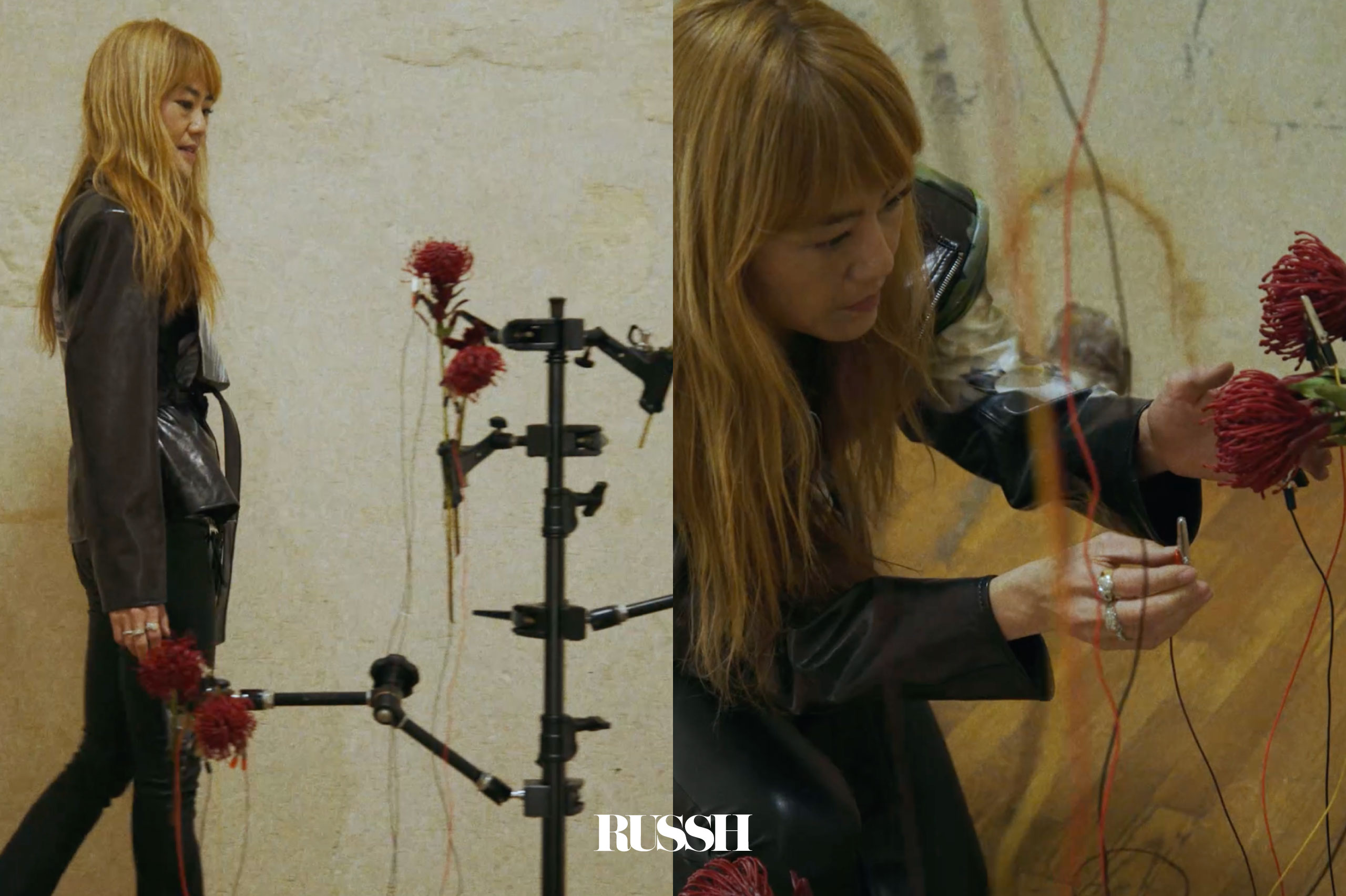
Ted and I had been delving into the resonance of the rose – its frequency and natural electrical signals. Ted’s technical knowledge has allowed us to translate these signals into data, then map them into sound through a synthesiser, allowing the flower’s activity to become an evolving sonic composition. This brings the flower far beyond what can be seen, into what can also be felt.
Australian botanicals sit at the heart of Unfurled. What is it about the Australian natural landscape – its forms, textures, or contradictions – that you find creatively compelling?
There is an inherent harshness to the Australian landscape. Its contrast breeds both resilience and an incredible uniqueness. The waratah, for example, thrives on the intensity and brutality of the climate, actually growing faster, bigger, and more colourful when the conditions are harder. The forms created by nature with these Australian native flowers have come from grit.
Creatively, this is an idea I live for. You cannot break something that is already broken. These flowers don’t just survive; they thrive in the fire. How cool is that?
There’s a sense of movement embedded in both the idea of something unfurling and in the collection itself. How do you think about movement when you’re making work?
All of my life and work is about movement. I suppose Newton’s First Law of Motion drives it all – and it is a nice summary of why I get out of bed in the morning.
The idea that an object remains at rest or continues moving at a constant velocity in a straight line unless acted upon by an external force: my obsession is to be that force, or to open my life to external forces to drive change and keep my existence dynamic, passionate, and delicious.
The Spring Summer 27 collection prints are literally shot in motion. I pumped paint syringes into Australian natives set inside tanks of water. As the paint moves, Ted shoots hundreds of frames of the work unfurling, moving, and revealing itself.

You’re working with the frequencies emitted by flowers, translating their electrical signals into sound and scent. What interested you in the idea of making something we can’t ordinarily perceive tangible?
If intangible means something you can’t physically touch or see, then everything intangible is what interests me. All science aside – I’ll leave that part for Ted and his technical genius – for me, life starts and ends with all that cannot be seen, but can definitely be felt.
Plato had a theory of “visual fire”, where he believed vision came from a fire within us reaching outward, meeting the world, and returning as perception. Basically, meaning that ‘seeing’ anything was not a passive act. In the same way, the frequencies any living object or being emits can be felt. Resonance is when these frequencies connect: notes are formed, melodies are produced. The senses are not limited to the eyes, nose, or ears; they are to be absorbed through your whole body.
You’ve created this work with Ted, and now it exists in conversation with Aje’s own creative language. How does working between different perspectives change your relationship to an idea?
I don’t think I can change my relationship to an idea. Once it’s on, it is on. Through Ted’s technical nuances and consideration, combined with Aje’s soft beauty and brand philosophies, I’ve been able to sculpt and transform my initial ideas and visions for this project, but the essence of my relationship to the idea is immutable. We are not unfurling outward like a hot mess in slow motion.
This story is about inner strength and the infinite space we have within ourselves to not only explore, but also create from. Only in solitude can we access this. It is slow, deep, and impermeable.

There’s a tension in the Australian landscape between delicacy and harshness, beauty and wildness. Is that duality something you recognise in your own practice?
My interest always sits with the imperfect. A broken glass will always be more beautiful to my eye than a perfect one. I break my own work and glue it back together – a process that takes a long time, where I make a point of standing there while the plaster is setting with glue, my fingers holding the pieces I had kicked and smashed only moments prior.
I could easily have an assistant do this part of my process, but it is my favourite stage. Usually because it’s just at this moment, where I’m stuck for 10 to 15 minutes, that I get thirsty, need to use the bathroom, or experience anything else that ensures the process ends up being a pain in the ass. Without such self – inflicted annoyance, the entire process would just be an act of destruction. The flip side – the new creation and the merging of the dual parts – is what makes it all worthwhile.
Scent can be so closely tied to place and memory. Were there particular landscapes, memories, or sensations from Australia that you found yourself returning to?
The scent of truth. That lives in the metaphorical guts of every human being – your inner self. It is the feeling when you know you’re on the right path, when you know your life is exactly as it is meant to be in that moment. These moments are mostly felt in nature.
Instead of taking a literal interpretation of the scents in the Australian landscape, Ted and I went searching for sounds to relay this feeling, this sense of a consummated moment in time. He captured the birds, the trees, the ropes knocking on boats in Sydney Harbour – all of the beautiful sounds that make Australia so unique. Pushed through synthesisers, he created the music for the Aje runway and showroom, all set to a human pulse.
There’s something compelling about bringing imagery rooted in Australia to Paris, a city with such a weight of fashion and art history. How does it feel to see the work occupy this space?
It feels fucking excellent.


