
Sofia Coppola once said she wanted her films to capture “the feeling of being somewhere.” It’s a sentiment that lingers at Bali’s Moon Gang, where atmosphere takes precedence over any kind of itinerary. Here, design decision seems intended to slow the body and quieten the mind. Hidden amongst the rice fields and jungle above Ubud, the five-suite retreat feels like a cinematic world of its own.
Designed by Sydney’s YSG Studio, the former concrete residence has been reimagined as a modern sanctuary infused with Balinese philosophies, Japanese architectural references and an unmistakably cosmic point of view. Recycled earth renders, indigo-dyed interiors, bamboo structures and handcrafted pieces by more than 15 Indonesian artisans create spaces that invite curiosity rather than consumption. A vinyl listening lounge, botanical spa and immersive wellness experiences encourage guests to disconnect from the demands of daily life and reconnect with creativity, community and place.
RUSSH spoke with YSG Studio founder Yasmine Ghoniem about designing the resort, collaborating with local makers and why the most memorable interiors are the ones that make you feel something.
At Moon Gang, the architecture dissolves the boundary between landscape and interior. How did you approach designing spaces that feel both built and grown from the Balinese hillside?
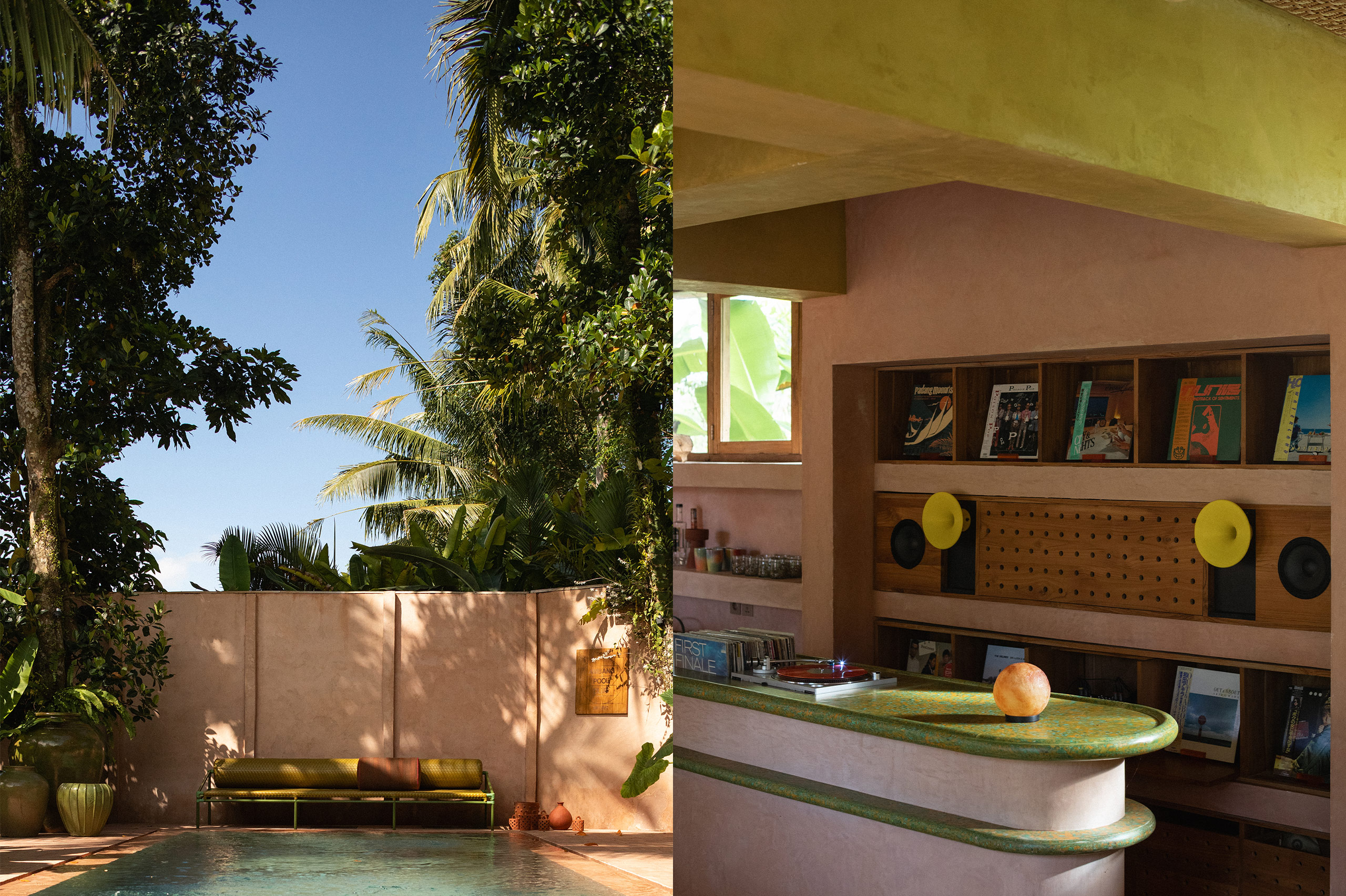
Moon Gang hugs a hillside, so you can’t see any of it before you enter through its timber gates with carved inset moons. As you walk down the steps to the pool patio, I wanted it to feel like you were encountering an ancient apparition. That’s why the walls were rendered in an earthy cinnamon-toned render. Zesty lime tones are the furnishing shades in the communal spaces and suites, drawing the surrounding jungle of coconut fronds that rise over the walls within.

The project uses recycled and bio-based materials throughout the interiors. How did sustainability shape both the aesthetic direction and the practical design choices across the hotel?
By way of background, Moon Gang is owned and operated by Kirsten Millbank from Firstbase Studio, an Australian multidisciplinary platform. She was keen from the get-go to create a hotel built with locally sourced, eco-conscious materials that genuinely supports wellbeing through calm spaces with just the right balance of energy. Kirsten manifested closely with Tory Bauer from the creative consultancy, Dance Card, who worked with Byron Bay’s The Sunseeker and has creative ties with Lucy Folk. I couldn’t say no to their brief. They envisioned a sanctuary that embraced Indonesia’s ancient and modern health, music and spiritual rituals, adding its own cosmic spin with lots of experiential activities, so the setting had to accommodate full mind and body immersion.
We honoured Kirsten’s building request, using a recycled earth-based render for most walls, cloaking the spa and ensuites in a deep inky blue plant-based indigo render. Tapping into the contemporary creative community, we collaborated with Indonesia’s most innovative makers and artisans who experiment with natural and recycled materials to craft our furniture and furnishing designs. Combined, they include hand-woven chairs and pool lounges through to cosmic looking floating counter surfaces and lighting made from upcycled plastics, banana leaf, reclaimed timbers and bamboo. Even the suite curtains are hand-dyed from indigo, mango, coconut and ketapang leaf extracts.

Indigo recurs throughout the suites as both pigment and atmosphere. What emotional or sensory register were you hoping to unlock through this immersive use of colour?
It’s also the shade of the natural render inside the spa. It’s a very meditative, quiet tone, that inspires a restful state.
Designed by YSG Studio, the interiors feel almost theatrical in their layering of texture, light and form. How did you balance conceptual expression with liveability across the five suites?
Each suite provides ample space (indoors and out) to unwind and rewind. Some feature a built-in lounge, while others include more generous private outdoor living areas. All feature large creativity desks where you can sit and paint or write – they’re are propped up by thick bamboo supports that look like elephant legs. We made sure there was ample room around the beds so that guests really feel a sense of space. In most, blue pendants hang bedside like floating clouds (they’re made from banana leaf dyed with Indigo).
The hand-dyed curtains really steal the show with their shades of marigold, matcha green, aqua and deep sea blues. In some suites, they flow from the upper level sleeping quarters down to the ground floor entry. Lying in bed, you can while away time watching sunlight filter across their watercolour-like patterns. Walls of breeze blocks frame the private courtyards and parts of the ensuites. Their altered orientations reference printed woodblock patterns and cast magical patterned fusions of sunlight upon the bathroom walls.

Many of the interior objects – pendants, furniture, even signage – are handmade by Indonesian collaborators. How did these partnerships shape the final spatial identity of the hotel?
Without our collaborations with local makers and artisans to craft our designs, Moon Gang would feel far less authentic. It was challenging though as it took a lot of sleuthing to find them across Indonesia. Kirsten and Tory were amazing, tracking local building, and commissioning some site-specific pieces including an outdoor sculpture.
We met with each of our makers personally to really relay the inspiration behind each piece. It wasn’t easy overseeing everything mostly from Sydney either. It took a lot of shop drawing reviews and WhatsApp messages, but we got there. The really satisfying results were seeing how our designs pushed their making techniques (and outcomes) in previously unexplored ways. I love that Moon Gang has a balanced mix of natural custom furnishings including timber and bamboo tables, plus really cosmic elements like the speckled coloured plastic counters in the Nongkrong Lounge and Cosmos Kiosk (the store), plus coloured resin door handles and matching room signage.
The listening bar and vinyl library introduce a sonic dimension to the interiors. How important was sound in the spatial design narrative, and how did it influence material or layout decisions?
Vital! It was something Kirsten talked to me about in our first meeting. Guests are instantly in awe of the DJ desk and vinyl library in the lounge. Even the sound system is custom made by locals and features bright yellow-stained timber speakers. A really cool aural feature is a site-specific innovation by Bottlesmoker, an Indonesian dance/electro duo that Kirsten discovered. Their programmed systems convert plant frequencies into musical notes connected to speakers. The soundscape forms a hypnotic backdrop beat in the lounge area where potted plants sit on shelves, plus amongst the open deck above the spa where we allocated space for a wall of greenery. The subliminal notes filter throughout the outdoor spaces and some of Moon Gang’s complimentary activities like breathwork and yoga work in tandem with the sounds.

The suites include unexpected objects like telescopes, watercolour sets and analogue cameras. How do these interventions shift the interiors from static accommodation into a more experiential environment?
These inclusions – each unique to every suite – hopefully inspire people to relax and play with them. I like the idea of friends in different rooms swapping them with each other too. One features a Walkman with a collection of cassettes, which is a personal fave, although heading up to a rooftop suite to star gaze with a drink in hand is pretty special.
There’s a clear interplay between Japanese architectural references and Balinese spatial traditions. How did these influences coexist without becoming pastiche within the interiors?
There are familiar Balinese elements in the design given the communal spaces have a porous connection to the outdoors, but rather than the more customary ‘open wall’ scenarios, we sculpted these connections to enhance outlooks. A deeply set central arched portal channels a stunning view of the pool form the Nongkrong Lounge’s U-shaped cushioned seating, and organic portholes we carved into existing walls. My favourite is the largest one in the lounge with an amber moon light perched at the base of its curve. The best view into the lounge is at night when you walk past the opening as the DJ desk and vinyl shelves are glowing. They really draw you in to play. That’s essentially what this place is about, giving new experiences a go and letting them lead your next move.

We also incorporated Balinese rituals and traditions in unique ways. An inset black and white checkered tile pattern frames the pool’s edge (a nod to the Saput Poleng philosophy of maintaining balance, whereby checkered cloths wrap temples and holy statues). New timber shrines (all blesses on site) hang on walls, yet in uncustomary shades. Smaller colour-coded resin and timber versions act as suite signage instead of numbers (paired with matching tonal entry resin handles inspired by lava lamps) – another local maker collaboration. Staff place fresh little offerings on their ledges daily, which is such a beautiful touch.
As for the Japanese influences, they’re more of a starting point. Take the spa doors. They were inspired by shoji screens, but are made from bamboo that we dyed a deep charcoal indigo shade. When closed, the connecting edges of the two doors subtly depict lunar phases. The bamboo suite we designed for the rooftop was inspired by traditional Japanese huts, but we added an enormous circular skylight which is pretty magical at night as the sky shimmers with diamond stars.
The spa incorporates bamboo screening, lunar references and plant-led therapies. How did you translate ritual and wellness into architectural form and tactile interior experience?
It has a really Zen, hushed sentiment thanks to the deep Indigo walls. We were inspired by rustic Japanese settings, where internal surfaces carry traces of time. Beyond the shoji-style sliding bamboo doors we designed and stained Indigo, we added tactile, natural elements that complement the organic nature of the Fields of Yarrow spa products used: a distressed timber column that lends the space a really ancient feel, and a shou sugi ban timber waiting bench. Rows of painted paper lanterns flutter above, adding a soft glow. Adding a contemporary edge, and a jolt of drama, a metallic blue privacy curtain conceals the state-of-the-art beauty equipment in the treatment room.

From a design perspective, what does “luxury” mean in a place like Moon Gang – where material restraint, ecological thinking and sensory immersion all take precedence over traditional opulence?
Inspired by the vitality of the Tri Hita Karana principles (a Balinese concept for harmonious living), Moon Gang’s notion of ‘luxury’ is about creating an authentic setting that reflects
Indonesia’s progressive contemporary artistic scene. Our custom designs plus commissioned inclusions were all made locally with local materials (both natural and repurposed).
Many of the original furnishings embody otherworldly sentiments. The more guests settle in, the more they appreciate their details, which encourages them to open their minds to all the different experiences on offer. This internal fulfillment and sense of contained time-sovereignty that Moon Gang encourages is the ultimate indulgence.


